The Best Lovable Alternatives in 2026
Looking for something other than Lovable? Here are the best alternatives — from similar AI app builders to tools with more code access, better pricing, or built-in data visibility.
TL;DR
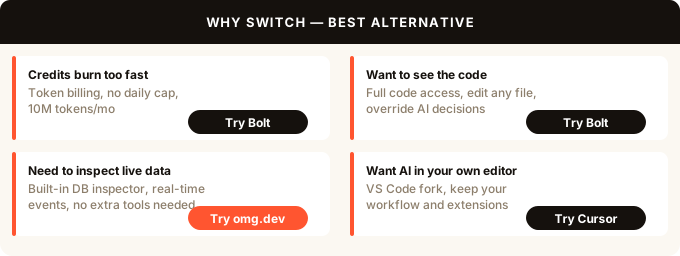
The best Lovable alternative depends on why you’re switching. If the credit system is frustrating you, try Bolt — token-based pricing and you can see the code. If you need to inspect your running app’s database in real time, try omg.dev. If you want AI help inside your own editor, try Cursor. If you need a no-code option without AI generation, Webflow or Bubble are the established choices.
Why people look for Lovable alternatives
Lovable is genuinely good at what it does. The most common reasons people look elsewhere:
- Credits run out fast. At 100 credits/month on the $25 plan, a debugging loop can eat a week’s budget in one session.
- Hidden code. Lovable hides the implementation by default. If you want to understand or edit what’s been built, you have to fight the tool.
- Locked into Supabase. Every Lovable project uses Supabase as the backend. If you need a different database or want to migrate later, that’s hard.
- No visibility into the running app. There’s no built-in way to inspect your live database or watch what your app is actually doing.
The best Lovable alternatives
Bolt — best for developers who want to see the code
Bolt is the most direct Lovable competitor. It builds full-stack apps from a description, but shows you the code as it generates it. You can read, edit, and override every file directly.
Pricing is token-based (10M tokens/month on Pro at $25/mo), which most people find more predictable than Lovable’s credits. Bolt Cloud launched in late 2025 with databases, auth, and hosting included.
Good if: you have some technical knowledge and want more control over what’s being built.
Not great if: you want polished default UI without tweaking anything — Lovable produces better-looking output by default.
omg.dev — best if you need to see inside your running app
omg.dev takes a different angle: every project comes with a built-in Inspect view that shows your live database tables, query activity, and event history in real time. When something breaks, you can see exactly what’s stored and what changed — without setting up any external logging.
Good if: you’re going past the prototype stage and need to understand what your app is actually doing as users interact with it.
Not great if: you just need a quick MVP with no interest in the data layer.
Cursor — best for developers in their own editor
Cursor is a VS Code fork with AI built into the editor. It’s not a drag-and-drop app builder — you’re still writing code — but AI handles autocomplete, multi-file edits, and complex refactors. If you want to stay in your own environment and keep full control of the codebase, Cursor is the standard tool in 2026.
Good if: you’re a developer who wants AI help without giving up your editor or your workflow.
Not great if: you have no coding knowledge. Cursor assumes you can read and reason about code.
Replit — best for quick experiments and learning
Replit is a cloud IDE with AI built in. It’s been around longer than Lovable or Bolt and supports almost any language or framework. The AI is less focused on generating complete apps from scratch, but it’s solid for smaller projects, learning, and fast prototypes.
Good if: you want a full browser-based development environment with collaboration features.
Not great if: you want the polished one-prompt-to-deployed-app experience that Lovable and Bolt offer.
v0 by Vercel — best for frontend components
v0 generates React and Next.js UI components from a description. It’s not a full app builder — it doesn’t provision a backend or handle auth — but for frontend work it’s very good. You describe a component, v0 generates it with Tailwind CSS, and you copy it into your project.
Good if: you’re a developer who wants to generate UI quickly without writing every component from scratch.
Not great if: you need a complete app with a backend. v0 is a component tool, not a full builder.
Webflow — best no-code option (no AI generation)
Webflow is a visual web builder for marketing sites, landing pages, and content-heavy pages. It’s not AI-generated — you design visually in a canvas interface. More control than any AI builder, but also more time investment.
Good if: you need a polished, design-controlled marketing site and don’t need AI to generate it.
Not great if: you need a database, user accounts, or any real application logic.
Bubble — best for complex no-code apps
Bubble is a no-code platform for building full web applications with custom logic, user auth, payments, and APIs — all through a visual editor. More powerful than Webflow, steeper learning curve, but you can build genuinely complex products.
Good if: you want to build a real app without coding and are willing to invest time in learning the platform.
Not great if: you want something up and running in an hour. Bubble takes longer to learn.
Quick comparison
| Tool | Code visible | Backend | Best for | Price |
|---|---|---|---|---|
| Lovable | Hidden | Supabase | Non-devs, polished MVPs | $25/mo |
| Bolt | Yes | Bolt Cloud | Developers who want control | $25/mo |
| omg.dev | Yes | Built-in | Live data visibility | Free trial |
| Cursor | Yes | Bring your own | Developers in their editor | $20/mo |
| Replit | Yes | Built-in | Learning, quick experiments | Free+ |
| v0 | Yes | None | React component generation | Free+ |
| Webflow | No | CMS only | Marketing sites | Free+ |
| Bubble | No | Built-in | Complex no-code apps | Free+ |
FAQ
What is the closest alternative to Lovable? Bolt is the most similar tool. Same pricing tier, same full-stack generation from a description, but Bolt shows you the code and uses token-based billing instead of credits.
Is there a free Lovable alternative? Bolt has a free tier with 1M tokens/month. Replit and v0 also have free tiers. Cursor has a free plan with limited autocomplete.
Can I export my Lovable project and move to another platform? Lovable projects use Supabase for the backend. You can export the database via Supabase’s tools. The frontend code is less straightforward to export cleanly. If portability matters, Bolt gives you full code access from the start.
Is Bolt better than Lovable? It depends on what you need. Bolt wins on pricing predictability and code access. Lovable wins on UI polish and backend setup simplicity. See the full Lovable vs Bolt comparison.
What if I need to inspect my app’s live data? None of the main tools give you this out of the box. omg.dev is built specifically for this — every project has a live Inspect view that shows your database tables and event history without any extra setup.