Lovable vs Bolt in 2026: Which AI App Builder Is Actually Better?
Lovable and Bolt are the two most popular vibe coding platforms. We compared them on speed, pricing, full-stack capability, and who each one is really built for.
TL;DR
Both Lovable and Bolt can take you from idea to deployed app in minutes. Lovable handles your database, auth, and hosting automatically and produces polished UIs out of the box. It’s the smoother ride for non-developers. Bolt gives developers more visibility into the code and a more predictable pricing model. The main gap both share: once your app is live, neither makes it easy to see what’s actually happening inside it.
Quick comparison
| Lovable | Bolt | omg.dev | |
|---|---|---|---|
| Pricing | $25/mo (credit-based) | $25/mo (token-based) | Free trial |
| Backend | Supabase (auto-provisioned) | Bolt Cloud (newer) | Built-in |
| Shows code | Hidden by default | Visible, editable | Visible, editable |
| Best for | Non-developers, polished MVPs | Developers who want control | Seeing your app’s live data |
| Biggest weakness | Credit burn on bug loops | Less polished UI output | Newer platform |
| Live sandbox | ❌ | ❌ | ✅ |
| Database inspector | ❌ | ❌ | ✅ |
What is Lovable?
Lovable is an AI-powered app builder where you describe what you want in plain English and it builds the whole thing: frontend, backend, and database. Every project comes with a Supabase backend, including database tables, row-level security, and authentication, all set up without touching any config files.
Lovable is designed for people who aren’t developers. The code is hidden by default. You steer the app through conversation, and Lovable handles the architecture. The output is consistently polished, with better default styling and layout than most competitors.
The main complaint is the credit system. Heavy users report burning through credits fast, especially when the AI gets stuck in bug-fixing loops. At $25/mo for 100 monthly credits, a few back-and-forth debugging sessions can eat a week’s budget.
What is Bolt?
Bolt is a browser-based development environment powered by AI. Unlike Lovable, it shows you the code as it’s generated. You can read, edit, and override it directly. Bolt’s pricing is token-based (10M tokens/month on Pro), which most users find more predictable than Lovable’s credit system.
Bolt launched Bolt Cloud in late 2025, bringing databases, authentication, and hosting into the platform. The integration works, though it’s newer and less tested than Lovable’s Supabase setup.
The main complaint is UI quality. Bolt’s output is less polished than Lovable’s by default. If you care about how the app looks, Lovable produces better results with less tweaking. Bolt works best if you know enough to give it precise direction.
Head-to-head: 5 things that actually matter
1. Pricing model
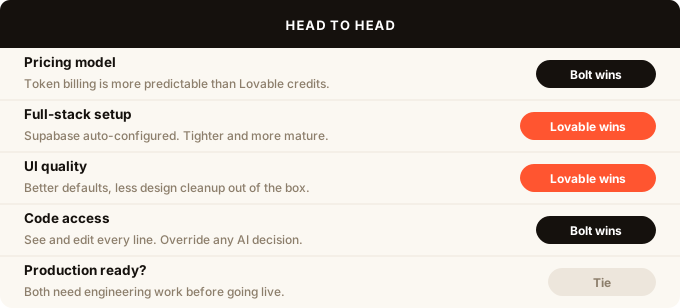
Bolt is the better deal here. Token-based billing is more predictable than Lovable’s credits. With Lovable, a debugging session can consume 20-40 credits without shipping anything. Bolt’s 10M token Pro plan gives you more room to iterate without watching a counter tick down.
2. Full-stack capability
Lovable wins. Its Supabase integration is tighter and more mature. Ask for a posts collection with a form, and Lovable creates the table, sets up RLS policies, and wires the frontend automatically. Bolt Cloud does the job, but the developer community is still building best practices around it.
3. Output quality
Lovable produces more polished UIs by default. Better typography, better component choices, better layout decisions. If your first impression matters for demos, investor pitches, or client work, Lovable’s output requires less cleanup.
4. Developer control
Bolt wins here. You can see every line of code, edit it directly, and override AI decisions. Lovable hides the implementation and you have to fight it to make granular changes. For developers who want to understand what’s being built, Bolt is the better environment.
5. Production readiness
Neither platform produces production-ready code out of the box. Lovable is upfront about this: it’s designed for prototyping and validation. Bolt gives you more code access, which means you can harden it yourself, but that requires engineering knowledge.
The gap both leave open
Lovable and Bolt share one significant blind spot: you can’t see inside your running app.
Both platforms generate and deploy code. Neither gives you a way to inspect your live database, watch what your app is actually doing, or understand why something broke, without setting up external logging tools from scratch.
This matters more than it sounds. When something breaks in production, like a form that doesn’t save or an auth flow that fails silently, you’re debugging blind. You re-prompt the AI to fix something you can’t directly observe, burning credits or tokens on guesswork.
omg.dev is built around this problem. Every project gets a built-in Inspect view that shows your live database tables, query activity, and event history as users interact with your app. No extra setup, no third-party tools. You can see exactly what’s stored, what changed, and when. That kind of visibility is hard to get from either Lovable or Bolt.
Which should you choose?
Choose Lovable if:
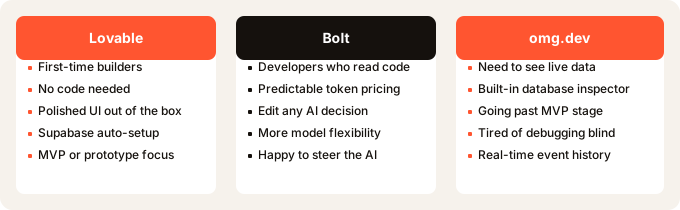
- You’re a non-developer building your first app
- You want a polished UI without tweaking design
- You need Supabase integration handled automatically
- You’re building a prototype or MVP for validation
Choose Bolt if:
- You’re a developer who wants to see and edit the code
- Predictable pricing matters more than polish
- You want flexibility to switch models or override AI decisions
Consider omg.dev if:
- You want to see your app’s live data as users interact with it
- You’re tired of debugging blind and want built-in visibility into what’s running
- You’re going beyond a prototype and need to understand what’s actually happening in your app
FAQ
Is Lovable or Bolt better for beginners? Lovable is better for complete beginners. It hides the code, guides you through the process conversationally, and produces more polished results without requiring technical decisions. Bolt suits beginners who have some coding knowledge and want to see what’s being generated.
Is Lovable worth $25 a month? Lovable is worth it if you’re actively prototyping and ship at least one project per month. The credit system gets frustrating if you hit debugging loops. Users building multiple projects at once often find the credits run out too fast and need to top up.
Is Bolt free to use? Bolt has a free tier with 1M tokens/month and a 300K daily limit. For most real projects, the free tier runs out within a few sessions. The Pro plan at $25/mo gives 10M tokens/month with no daily limit, which is enough for consistent daily use.
Can Lovable build a full-stack app? Yes. Lovable automatically provisions a Supabase backend for every project, including database tables, row-level security, and authentication. It’s one of the more complete full-stack vibe coding tools around. The trade-off is you’re locked into the Supabase ecosystem and can’t easily migrate the backend later.
Can Bolt build a full-stack app? Yes, since launching Bolt Cloud in late 2025. Bolt now includes databases, authentication, file storage, and hosting. The integration is newer than Lovable’s but works for most app types.
What is the best AI app builder in 2026? Lovable is the best for non-developers who want polished, full-stack MVPs. Bolt is the best for developers who want direct code control and predictable pricing. omg.dev stands out if you need to see what’s happening inside your running app: it includes a built-in data inspector so you’re not debugging blind.