What Is Vibe Coding? The Beginner's Guide to AI-Generated Apps
Vibe coding is how most people are building apps with AI in 2026. Here is what it means, how it works, what tools to use, and when it breaks down.
TL;DR
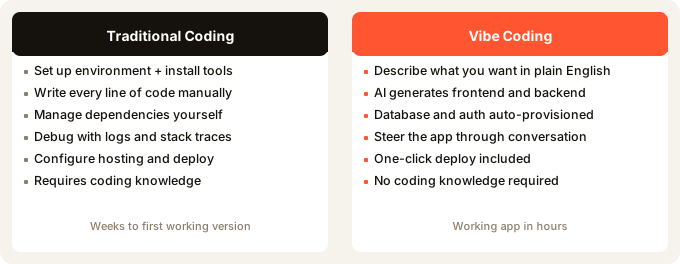
Vibe coding means describing what you want an app to do in plain English and letting AI generate the code. You steer by feel rather than by writing implementation yourself. The term was coined by AI researcher Andrej Karpathy in early 2025. The main tools are Lovable, Bolt, and Cursor. It works well for prototypes, MVPs, and internal tools. It breaks down when something goes wrong and you have no way to inspect what’s actually happening.
Where the term came from
Andrej Karpathy, one of the original researchers behind large language models, described vibe coding in a post in February 2025. He wrote about building software by feel — giving the AI a direction and accepting what it produces without diving into the implementation details. The name stuck because it matched what a lot of people were already doing.
What vibe coding actually looks like
You open a tool like Lovable or Bolt and describe what you want to build. Something like:
“A to-do app where tasks can be tagged by project and sorted by due date. Users should be able to sign in with email.”
The AI generates the full app: frontend, database schema, authentication, and sometimes hosting. You click around, see what it made, describe what needs to change, and keep going.
No file structure to set up. No dependencies to install. No config files to touch. The AI handles all of it.
Who vibe coding is for
People with no coding background who want to ship something real. Instead of learning to code or hiring a developer, they describe the app and iterate through conversation.
Developers who want to move faster. Even experienced developers use tools like Cursor to generate boilerplate, write tests, and handle the tedious parts of building — so they can focus on the parts that actually need thinking.
Founders and product people validating ideas before investing in a full build. A working prototype built with vibe coding tools in a few hours is enough to test assumptions with real users.
The tools people use
Lovable — best for non-developers. Hides the code entirely, produces polished UIs, and auto-provisions a Supabase backend. Steered entirely through conversation.
Bolt — similar to Lovable but shows the code. Better for people who want to understand what’s being built or make manual edits. Token-based pricing is more predictable than Lovable’s credits.
Cursor — an AI-first code editor for developers. You still write and review code, but Cursor handles autocomplete, multi-file edits, and complex refactors. Not really vibe coding in the purest sense, but the same spirit of letting AI do the heavy lifting.
omg.dev — built around the idea that you need to see inside your app while building it. Includes a live data inspector so you can watch your database tables and events in real time as users interact with the app.
What works well
Vibe coding is genuinely fast for the right kind of projects:
- Internal tools (dashboards, admin panels, simple CRMs)
- Landing pages and marketing sites
- MVPs for idea validation
- Prototypes to show stakeholders
- Simple apps with standard patterns (CRUD, auth, forms)
Building something that works and looks good used to take weeks. With vibe coding tools, it takes hours.
Where it breaks down
Debugging is hard. When something goes wrong, most vibe coding tools give you no way to look inside the running app. You re-prompt the AI to fix a problem you can’t directly see, which can turn into long loops of guessing.
The AI doesn’t always understand the real constraint. Vibe coding works well when the requirements fit common patterns. Unusual requirements, complex business logic, or non-standard architectures often produce outputs that look right but behave wrong.
You can get stuck. When a generated app has compounding issues, it’s sometimes faster to start over than to fix what exists — especially with tools that hide the code.
Real production apps need engineering. Vibe coding platforms say they’re for prototyping. They mean it. The output is a great starting point but usually needs professional attention before handling real user data, payments, or scale.
Is vibe coding “real” coding?
The debate misses the point. The question isn’t whether vibe coding counts as coding — it’s whether the output is useful. For a lot of projects at early stages, the output is very useful.
More importantly: the skill that matters with vibe coding tools isn’t typing syntax, it’s knowing what to build and being able to describe it clearly enough for the AI to get it right. That’s not easier than coding. It’s a different skill.
FAQ
Who invented vibe coding? The term was coined by Andrej Karpathy in February 2025. Karpathy is a researcher and former director of AI at Tesla, known for foundational work on large language models.
Is vibe coding just for beginners? No. Many experienced developers use AI coding tools to move faster. The difference is that developers use tools like Cursor that show the code, while complete beginners tend to use tools like Lovable that hide it.
Can you build a real app with vibe coding? Yes, for many definitions of “real.” Thousands of apps running real users were built with Lovable and Bolt. The limit is usually around complexity and production hardening, not whether the app can work at all.
What is the best vibe coding tool in 2026? Lovable is the best for non-developers who want a polished result fast. Bolt is better for developers who want to see the code. omg.dev is worth looking at if you need to inspect what your app is doing as it runs.
How do you start with vibe coding? Go to Lovable or Bolt, describe the app you want to build in one paragraph, and click generate. The first output takes a minute or two. From there you steer through conversation.
Is vibe coding free? Most tools have a free tier. Bolt offers 1M tokens/month free. Lovable has a limited free plan. Both paid plans start at $25/mo. Cursor has a free tier with limited autocomplete.