v0 vs Lovable: Which AI Builder Is Right for You?
v0 generates React components fast. Lovable builds full-stack apps. Here's an honest comparison to help you pick the right tool and ship faster.
TL;DR
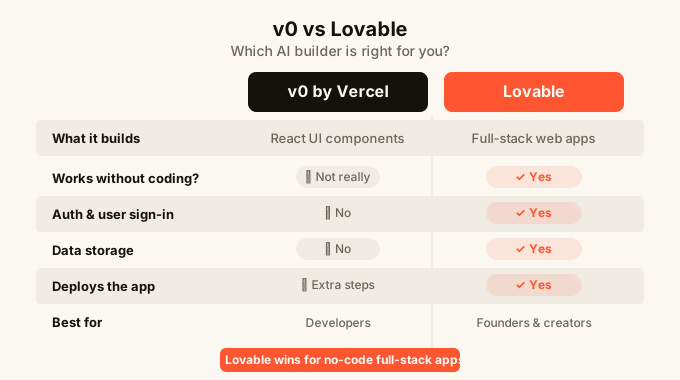
v0 by Vercel is a component generator (a tool that produces ready-to-use UI pieces like buttons, forms, and cards). Lovable is a full-stack app builder (it handles both the visual front end and the behind-the-scenes data storage). If you already know how to code and want beautiful UI pieces to drop into a project, v0 is fast and excellent. If you want a working app with user sign-in and a place to store data, Lovable gets you further without writing code yourself.
Quick Comparison
| v0 | Lovable | |
|---|---|---|
| What it builds | React UI components | Full-stack web apps |
| Works without coding? | Not really | Yes |
| User sign-in included? | No | Yes |
| Data storage included? | No | Yes |
| Real-time features? | No | Yes |
| Deploys the finished app? | Needs extra steps | Yes |
| Best for | Developers wanting UI speed | Founders and creators wanting a working app |
| Free tier | Yes | Yes |
What Is v0?
v0 is a tool made by Vercel (the hosting company behind much of the modern web developer world). You type a description of a UI element you want, and v0 generates the code for it using React (a popular way to build web interfaces) and a style library called Tailwind.
The output looks polished immediately. Ask for a pricing table, a login form, or a data dashboard, and you get clean, production-quality code back in seconds. Developers love it because it removes a lot of the boring, repetitive work of making things look good.
The catch: v0 gives you code, not an app. You still need a developer to take those components, wire them together, connect them to a database (where your app stores info like user accounts and content), add sign-in, and deploy everything to a live URL. For someone who does not write code, v0 is a bit like getting a flat-pack wardrobe with no instructions and half the screws missing.
v0 is genuinely brilliant at what it does. It is just not designed for the person who wants to go from idea to working app.
What Is Lovable?
Lovable is an AI app builder aimed at founders, product managers, and creators who want to ship a real working app without a full engineering team. You describe what you want in plain language, and Lovable builds it. The app is live and shareable as soon as it is built, no deployment step needed.
Lovable handles the full stack. That means: the visual interface your users see, the database storing their data, user sign-in, and hosting. You do not need to pick or pay for separate tools to stitch those pieces together.
The trade-off is that Lovable gives you less low-level control. A developer who wants to fine-tune every line of a component will find v0 more satisfying. But for someone who wants to validate an idea quickly or run a side project without hiring an engineer, Lovable closes a lot of gaps.
Head-to-Head: v0 vs Lovable
Building the visual side
Both tools produce visually polished results from a plain-language prompt. v0 is arguably better at generating a single beautiful component fast. Ask for a complex data table or an animated hero section and the output is impressive.
Lovable is also strong here, but its design output is part of a bigger process: it is building a whole app, not just one piece. If you want pixel-level control over a component, v0 wins on flexibility. If you want a coherent visual app across multiple screens, Lovable’s output is more consistent.
User sign-in
v0 does not include any sign-in (the system that lets users create accounts and log in). If you want authentication, you need to set it up yourself using a separate service, then write the code to connect it.
Lovable includes sign-in out of the box. Your users can log in with an email link or a fingerprint from day one. No extra account, no wiring up.
Storing your app’s data
v0 generates UI only. There is no database attached. If you want the app to remember anything (signups, posts, form responses), you need to add that separately.
Lovable includes a built-in place to save data. If you build a waitlist form, signups are saved. If you build a notes app, the notes persist. This is included with no setup.
Real-time features
v0 has no real-time capability built in. Live updates (where multiple people see changes instantly without refreshing) require extra work from a developer.
Lovable includes real-time collaboration out of the box. If you want a tool where multiple users see the same live data, it works from day one.
Deployment (getting your app online)
v0 gives you code. Putting that code online still requires a hosting step. Vercel’s hosting platform makes this relatively easy if you know what you are doing, but it is not automatic.
Lovable apps are live the moment they are built. There is a shareable URL ready to send.
Who actually builds with it
v0 is used almost entirely by developers. Most of the praise you see online is from engineers who already know React and just want a faster way to write repetitive UI code.
Lovable’s user base includes more non-technical founders and product people. It shows in the support documentation, the templates, and the way prompts are interpreted.
When to Choose v0
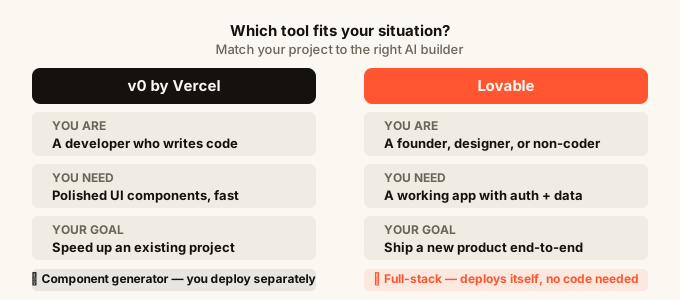
Choose v0 if you already write code, work inside an existing app project, and need to generate high-quality UI components quickly. It is excellent for design systems, prototyping interface ideas, or knocking out repetitive front-end work.
If you are a developer building on top of an existing back-end (the part of the app that handles data and logic behind the scenes), v0 slots in well. You are not looking for a complete solution, just a faster way to build the part users see.
v0 is also a good tool if your primary goal is learning React and you want to study clean, well-structured code examples.
When to Choose Lovable
Choose Lovable if you want to go from idea to working app without writing code. If you are a founder validating an idea, a freelancer building something for a client, or a creator launching a side project, Lovable gets you to a live, functional product faster.
Lovable also makes more sense if your app needs user accounts, stored data, or real-time collaboration, because those are included without extra work.
The honest limitation: Lovable gives you less control at the code level. If you have very specific technical requirements or need to integrate something unusual, you may hit a ceiling. For most “I want to build and ship a useful app” use cases, that ceiling is far enough away that it will not matter.
What Neither Tool Does Well
Neither v0 nor Lovable is designed to be used on a phone. Both expect you to sit at a desktop computer to do real work. If you are someone who builds ideas on the go, that is a meaningful gap.
Both tools also focus on shipping fast from a prompt, but neither has a dedicated design preview step before the build. You describe, it builds, and if you do not like the result, you prompt again. That means more trial-and-error iterations, which costs time and credits.
These gaps are worth knowing before you commit to a workflow. If you are comparing options, the best AI app builder 2026 roundup covers more tools across both the developer and no-code spectrum.
The Third Option: What About Tools Built for Non-Developers?
v0 and Lovable are both excellent products, but they were both built with at least some developer intuition in mind. v0 is explicitly for developers. Lovable is friendlier, but the community, templates, and feature set still assume you are comfortable poking around code when needed.
If your starting point is “I want to build an app and I do not write code at all,” tools like omg.dev take a different approach. omg.dev is designed to be used from your phone, includes a design preview step before anything gets built, and ships with user sign-in, data storage, real-time features, and hosting all included. The difference in philosophy is: it was built for the person who wants to ship something useful, not for the developer who wants a faster coding tool.
For a broader look at what falls under this category of building without coding, the guide on how to build an app without coding is a useful read.
How to Choose: The One-Question Test
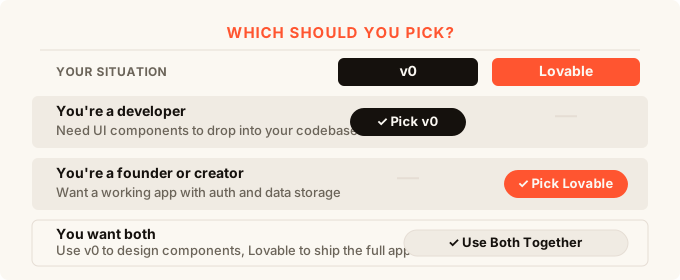
Ask yourself: “Do I write code, and am I adding this to an existing project?”
If yes, v0 is faster and more flexible for your use case.
If no, or if you are starting from zero and want a whole working app, Lovable (or an all-in-one no-code builder) will get you further.
The people who are most frustrated with v0 are the ones who expected it to be an app builder when it is actually a component generator. The people most frustrated with Lovable are developers who wanted fine-grained code control and found themselves fighting the abstraction. Match the tool to your actual starting point and you will save yourself a lot of re-work.
For more context on how these tools compare to a wider set of AI coding tools, the Lovable alternatives guide is a good next step.
FAQ
Is v0 free to use?
v0 has a free tier with a monthly limit on generations. Heavier use requires a paid plan. The pricing is usage-based, so light users can get a lot done for free.
Is Lovable free to use?
Lovable also has a free tier with limits on how many projects and build credits you get. Paid plans unlock more builds and private projects. For testing an idea, the free tier is usually enough to see if the tool fits.
Can I use v0 without knowing how to code?
In practice, no. v0 generates code you need to paste into a project and connect to other things. Without development knowledge, you will get stuck before you see a working app.
Can Lovable build an app that multiple users can sign into?
Yes. User sign-in is included in Lovable by default. You do not need to set up a separate service for it.
Which one is better for mobile apps?
Neither v0 nor Lovable builds native mobile apps (apps you download from an app store). Both produce web apps that work in a mobile browser. If mobile-first is important to you, check tools specifically built with that in mind.
What if I start with v0 and want to add a database later?
You can, but it requires developer work. You will need to choose a database service, connect it to your project, and write the code to read and write data. It is doable but not automatic.
I want to build a real-time collaborative app. Which tool should I use?
Lovable includes real-time features built in. v0 does not. If live collaboration (multiple people seeing each other’s changes instantly) is a core requirement, Lovable is the right starting point between the two. If you want a phone-first option with real-time built in, omg.dev is worth a look too. The Lovable vs Bolt comparison also covers how these full-stack builders stack up against each other.