Framer vs Lovable: Which Builder Is Right for You?
Framer vs Lovable compared side by side: design control, AI features, real app logic, and pricing. Find out which tool fits your project.
TL;DR
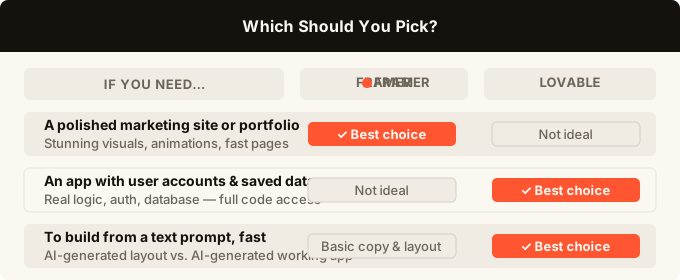
Framer is a website builder with polished design tools and great animations. Lovable is an AI app builder that writes code from a text prompt and can handle real logic like user accounts and saved data. If you want a beautiful marketing site, Framer is hard to beat. If you want an app that actually does something, Lovable is the better starting point.
| Framer | Lovable | |
|---|---|---|
| Best for | Marketing sites, portfolios | Interactive apps, side projects |
| How you build | Visual canvas + AI copy | Text prompt to generated code |
| User accounts | No | Yes |
| Saves data | No | Yes |
| Custom code | Limited | Full code access |
| Free plan | Yes | Yes |
| Mobile building | No | No |
What Is Framer?
Framer started as a design prototyping tool, then turned into a full website builder. Today it sits somewhere between a drag-and-drop editor and a professional design tool. You place elements on a canvas, set up animations, and publish when you’re ready.
The output is a real website, not a PowerPoint slide. Framer generates clean, fast pages and hosts them for you. It has an AI feature that writes copy and can generate basic page layouts from a text prompt, but the core experience is still hands-on visual design.
Framer shines when looks matter most: agency portfolios, SaaS landing pages, personal sites. Designers love it because it gives them precise control over spacing, fonts, and motion without needing a developer.
What Is Lovable?
Lovable (previously known as GPT Engineer) is an AI app builder. You type what you want to build in plain English, and it generates a working app, not just a page. That means it can wire up user logins, store data in a database (where your app keeps information like sign-ups, posts, or orders), and connect to outside services.
The result is actual code you can inspect, edit, or export. Lovable deploys your app so it is live immediately. You can keep refining it through chat, asking for new features or changes the same way you described it the first time.
Lovable is aimed at founders, makers, and teams who want a functional product without hiring a developer. The gap it fills is not “make my website look great” but “build me a thing that works.”
Head-to-Head: Framer vs Lovable
Design Control
Framer wins this category without much debate. The canvas-based editor gives you pixel-level control. You can set exact spacing, choose from hundreds of fonts, create complex scroll animations, and build a component library (a set of reusable design pieces). Designers who have used Figma will feel at home.
Lovable does not have a design canvas. You describe what you want and the AI picks a layout. You can ask it to change colours, fonts, or spacing through prompts, but you are not dragging things around. The result looks clean but it is not the same level of craft.
If your project lives or dies on a specific visual identity, Framer gives you the control. If “looks good” is good enough and you need the app to actually function, Lovable gets you there faster.
App Logic and Real Features
This is where Lovable pulls ahead. A Framer site cannot remember who you are. It cannot let users sign up, save their preferences, or interact with each other. It is a website, not an application.
Lovable can build all of that. User authentication (letting people create accounts and log in), a database for storing information, and dynamic pages that change based on who is logged in are all things Lovable can generate from a prompt.
If you are building a todo app, a member directory, a feedback tool, or anything that involves accounts and saved data, Framer is simply not the right tool. It was not built for that.
AI Features
Both tools use AI, but in different ways.
Framer uses AI mostly for content. It can generate page copy, suggest layouts, and produce basic designs from a prompt. It is helpful for getting a blank page started, but the AI is an assistant inside a traditional editor.
Lovable’s AI is the editor. Every change goes through a chat prompt. This is a bigger bet on AI doing the work rather than helping you do the work. For non-developers, that is actually easier: you do not need to learn the tool’s design system or figure out where settings live. You just describe what you want next.
Customisation and Code Access
Framer lets you write custom code in components, but it is fairly limited and assumes you know what you are doing. The main experience is the visual editor, and going off-road requires some developer comfort.
Lovable gives you the full generated code. You can see it, copy it, and deploy it somewhere else if you want. For people who want to eventually hand a project to a developer, that portability matters.
Pricing
Both have free plans with limitations. Framer’s paid plans are structured around traffic and custom domains. Lovable’s paid plans are structured around usage, since generating or editing an app costs credits.
The main cost difference: Framer is predictable month-to-month if your traffic stays steady. Lovable can get expensive if you iterate heavily on a complex app. Plan your builds, avoid back-and-forth, and the credits go further.

Real Use Cases: Which Tool Fits Which Project?
You want a landing page for your startup
Use Framer. It will look better, load faster, and you can control every pixel. The AI can generate a first draft, you refine it, and you are live in a day.
You want to build a simple SaaS tool
Use Lovable. Your tool needs user accounts, saved data, and pages that do something when a button is clicked. Framer cannot do that. Lovable can get you a working prototype fast.
You want a portfolio site
Framer. Full stop. The animation controls and design precision are made for this.
You want to test a product idea fast
Lovable is better here. You can describe an idea, get a working version, share a link with potential users, and see if they actually use it. That feedback loop is more useful than a beautiful page that does nothing.
You want both: a great-looking app
This is where things get interesting. You can use Framer for your marketing site and Lovable for the actual product behind the sign-up button. Many small teams do exactly this.
Where Both Tools Fall Short
Framer does not do apps. That one limitation rules it out for a wide category of projects. If your idea involves users doing things, storing things, or seeing different things based on who they are, Framer is not the tool.
Lovable’s weakness is design precision. The AI makes reasonable choices but you cannot obsess over spacing the way you can in Framer. For consumer apps where first impressions are everything, the gap in visual polish matters.
Both tools also require a desktop. Neither Framer nor Lovable lets you build from your phone in any meaningful way. If you want to work on your project during a commute or away from a desk, you are stuck.
What About Other Options?
Framer and Lovable are not the only tools on the market. If you are comparing more broadly, it helps to know where they sit.
For website builders, tools like Webflow and Squarespace are in Framer’s category. For AI app builders, Bolt and other tools sit alongside Lovable. You can read a direct comparison of Lovable vs Bolt if you are deciding between AI app builders specifically.
If you want to understand the broader category before picking a tool, what is vibe coding explains the idea of building software through conversation rather than traditional code, which is the approach both Lovable and Bolt take.
For a full list of Lovable alternatives, including tools that take different approaches to the same problem, the Lovable alternatives guide covers the landscape well.
And if you want to build from your phone, which neither Framer nor Lovable supports properly, omg.dev was built phone-first. You can describe, design, and ship an app from your home screen. It includes user accounts, real-time features, and data storage out of the box, no separate accounts to set up.
Which Should You Use?
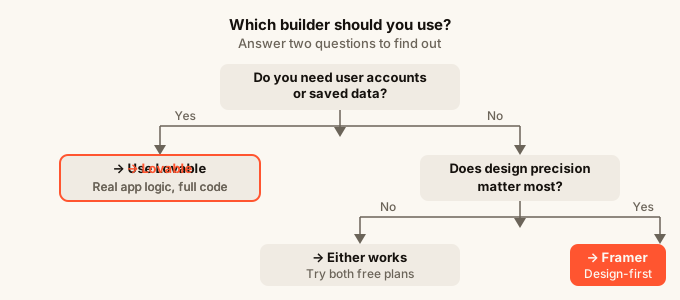
The honest answer is that Framer and Lovable are not really competing for the same projects.
Choose Framer if you are building a website. A marketing page, a portfolio, a landing page for a product. You want design control, great animations, and fast loading. You do not need user accounts or saved data.
Choose Lovable if you are building an app. Something users log into, interact with, and come back to. You need logic, not just looks. You want a working prototype fast and you are willing to accept less visual precision in exchange for actual functionality.
If your project needs both, build the public-facing site in Framer and the product itself in Lovable. Many small teams run exactly this setup and it works well.
The trap to avoid is using Framer when you need an app because it looks easier, or spending days polishing a Lovable project in chat when you really just need a landing page. Know what you are building first, then pick the tool.
FAQ
Is Framer good for beginners?
Yes, with a caveat. The drag-and-drop canvas is learnable and the AI can generate a starting point from a prompt. But design tools have a learning curve compared to fully prompt-driven builders. If you have never designed a page before, expect to spend a few hours getting comfortable.
Can Lovable replace a developer?
For early-stage prototypes and small internal tools, often yes. For large-scale production apps with complex requirements, a developer will still need to step in eventually. Lovable is best thought of as getting you 80% of the way there very quickly.
Does Framer support e-commerce?
Not natively. You can embed third-party checkout tools, but Framer is not an e-commerce platform. If you need a proper online store with inventory and payments, look elsewhere.
Can I export my project from Lovable?
Yes. Lovable gives you access to the generated code. You can take it, host it yourself, or hand it to a developer to continue building.
Which is better for SEO?
Framer has a slight edge here for purely informational sites. Its pages load fast, it handles meta tags well, and it is built for static content that search engines index easily. Lovable apps can be SEO-friendly too, but they often involve user-specific content that does not need to rank in search.
Can I use both Framer and Lovable for one project?
Yes, and it is a sensible approach. Use Framer for your public marketing site and Lovable for the product your users actually log into. They can live on different subdomains and work independently.
What if I want to build an app from my phone?
Neither Framer nor Lovable is built for mobile building. If that matters to you, omg.dev is designed specifically for building and shipping apps from a phone. It includes built-in user accounts, real-time features, and data storage, and you can go from idea to live app without opening a laptop. It covers the same ground as how to build an app without coding in a fully mobile workflow.